
The Physical Impossibility of Death in the Mind of Someone Living: The Incompletability of Understanding Death
We can understand death, witness it in others, and come close to it ourselves. But we cannot undergo our own death and then return to understand it. Death sets a boundary that neither knowledge nor experience can fully cross.
We can understand death, but we can never complete our understanding of our own death.
The reason is structural. While we are alive, we cannot experience our own death as a completed event. Once death occurs, the capacity to continue experiencing, reflecting, and understanding ends with life itself.
This is the incompletability of understanding death.
It does not mean that death is unknowable. We know that people die. We understand much about how death occurs, what it does to the body, and how it ends a human life. We can witness the deaths of others, come close to death ourselves, and reflect deeply on mortality.
What we cannot do is undergo our own death and then continue to understand what has happened.
Our own death cannot be complete while our understanding of it continues.
Death and Understanding Cannot Be Completed Together
Most experiences remain open to later understanding.
Illness, failure, loss, and catastrophe may transform a life, but if we survive them, we can return to what happened and understand it differently. The experience has ended, while reflection continues.
Death is different.
Before death, we may anticipate it, fear it, imagine it, or come very close to it. But as long as experience and understanding continue, our death has not yet occurred.
Once death occurs, the opposite limit appears. Life has ended, and with it the possibility of further experience and reflection.
The difficulty is therefore not simply that we lack sufficient knowledge. It lies in the structure of death itself. While alive, we cannot experience our own death as completed. Once dead, we cannot continue to understand it.
We can continue to approach death and deepen our understanding of it, but we cannot both undergo our own death and remain able to comprehend what has occurred.
Another Person’s Death Cannot Become My Own
The death of another person can make death real in a way that abstract knowledge cannot.
When someone close to us dies, death ceases to be merely the proposition that “everyone dies.” A life has actually ended. Someone who once answered no longer answers. A relationship that existed in both directions has been broken.
Yet another person’s death remains another person’s death.
I can suffer the loss of someone. I can learn more about death through that loss. I can see how death ends a life and alters the lives of those who remain. But their death cannot become my own.
The death of others therefore brings death closer while also revealing the limit of what their death can teach us.
We can learn about death through the deaths of others.
We cannot experience our own death through theirs.
Coming Close to Death Is Still Not Death
Near-death experiences appear to bring us closest to the boundary.
Serious illness, an accident, resuscitation, or the immediate expectation of death can radically alter a person’s understanding of life. Death ceases to be remote and becomes an imminent possibility.
Such experiences may be profound. But they remain experiences of the living.
If someone can later remember what happened, describe it, and reflect on it, then what occurred was an encounter with the approach of death, not death itself.
Proximity does not remove the boundary.
We may return from the edge of death.
We do not return from death itself.
Death Ends Reciprocity Between the Living and the Dead
Damien Hirst’s The Physical Impossibility of Death in the Mind of Someone Living (1991) gives this boundary a physical form.
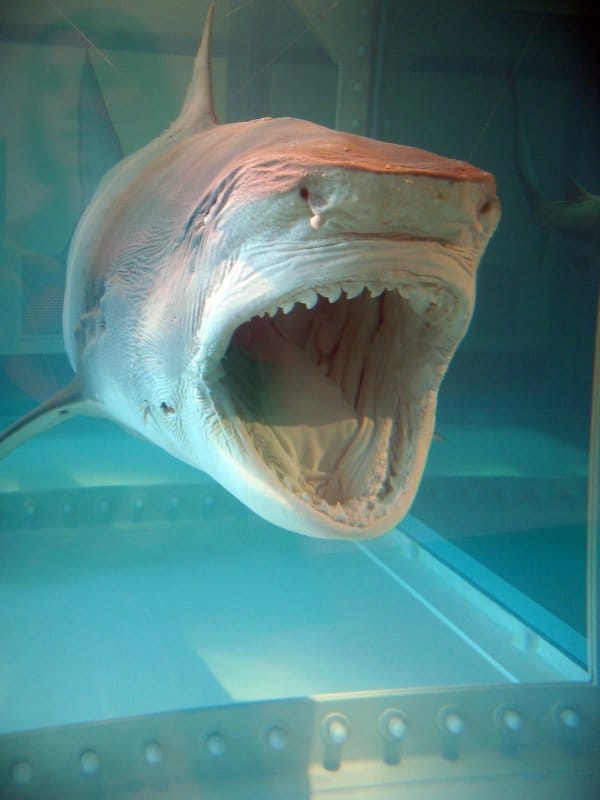
The dead body is before us. We can look at it, examine it, interpret it. Death appears almost entirely exposed.
Yet the living and the dead remain divided by a boundary that cannot be crossed in both directions.
We cannot restore the dead to life. We cannot cross beyond the boundary that separates the living from the dead, acquire an understanding of death there, and then return. Nor can the dead return to answer us.
This is not emotional indifference. A living person may grieve deeply, love the dead, preserve their memory, and wish above all else to bring them back. None of this changes what death has made impossible.
Death ends reciprocity.
Between living persons, understanding can be corrected. I may misunderstand you, and you can answer me. I may ask what you meant, and you can revise my judgment. Action and understanding remain reciprocal.
Death ends that relation.
The living may continue to act in relation to the dead, but they can no longer act with them. They may remember, interpret, preserve, or mourn, but the dead cannot respond.
Death therefore does more than end biological life. It ends the mutuality on which action, understanding, and communication between persons depend.
We may think we understand death because we have seen the dead and know what death does from our side of the boundary.
But all such understanding remains the understanding of the living.
Why This Matters for Life
The incompletability of understanding death is not merely a limit of knowledge. It defines the conditions under which we have to live.
We cannot first complete our understanding of death and only then decide how life should be lived.
Life does not wait.
We continue to act while our understanding remains incomplete. We spend finite time, make choices, and leave behind a past that cannot be lived again.
Death therefore reveals something more fundamental than the fact that life ends:
our understanding of death can never be complete, while life moves irreversibly forward.


Comments